
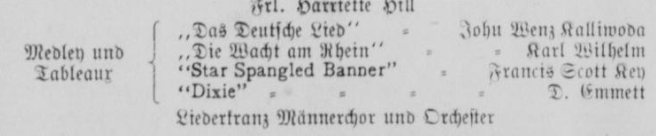
I came across a fun little treasure in the Anzeiger, one of Grand Island, Nebraska’s historical German language newspapers. On October 15, 1912, the Liederkranz planned to hold a concert for its grand opening and published its program in the paper. This brief snippet highlights their unique German-American identity, rooted in different conceptions of liberty.
German-ness through typeface
Notice how the German is printed in Fraktur while the English is printed in Antiqua? This is a convention that goes back centuries in Germany and it is interesting to see it carried over to the German press in America. If the word isn’t German, it shouldn’t look German. More on the history of Fraktur later, but for now, notice that the printer had to switch out typefaces in the middle of the line to achieve this effect.
Anthems of a Failed Revolution
This song selection is also quite the patriotic line up. The two German language songs have special significance for a community whose founders fled Germany in the wake of the 1848 failed Revolution. Das Deutsche Lied (The German Song) lifted up the idea of a unified fatherland over the individual principalities that made up the German Confederation. It was a plea for national unity characterized by individual rights and liberty. It became a sort of unofficial anthem of the revolution, but quickly died away as the revolution failed and its organizers persecuted. The third stanza would eventually become the national anthem of a united Germany after the second World War. By 1912, it was largely relegated to cultural memory. That memory, however, was alive and well in Grand Island, Nebraska.
The other German song is equally as meaningful. Max Schneckenburger wrote Die Wacht am Rhein (The Watch on the Rhine), in response to France’s attempt to claim the Rhine as their eastern border in 1840. The conflict was short-lived. Prussia stationed troops along the Rhine, but the resignation of the French Prime Minister avoided any military escalation. Still, the threat made Germans nervous and brought on a wave of German nationalism, affirming the Rhine as fundamentally German. Imagery surrounding the Rhine entered the national consciousness and Die Wacht am Rhein became an anthem of its own, indicating allegiance to a united Germany. Just how powerful that was can be seen in the choice of a Liederkranz in a small Nebraska town to include it in their Grand Opening line up.

One thought on “Two Anthems: How German-Americans in Grand Island signaled their transatlantic identity”